


RealClearInvestigations Newsletters: RCI Today
RealClearInvestigations' Picks of the Week
RealClearInvestigations' Picks of the Week
August 9 to August 15
RCI Podcasts & Videos
On this week’s episode of the RealClearInvestigations Podcast, RCI Editor J. Peder Zane and RCI Senior Reporter James Varney speak with true crime reporter extraordinaire Valerie Bauerlein of the Wall Street Journal about her recent coverage of the Nancy Guthrie abduction, her book on the Alex Murdaugh murder case and her podcast on another South Carolina homicide, “Camp Swamp Road.”
Featured Investigation:
How Hamas’ Attack on Israel Is Transforming American Politics
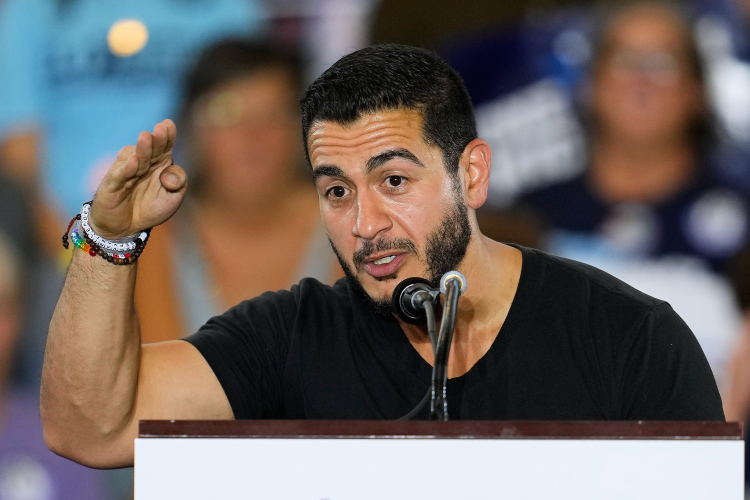
Ben Weingarten reports for RealClearInvestigations that Abdul El-Sayed’s victory in Michigan’s Democratic Senate primary is the latest sign of an emerging kingmaker in U.S. politics: American Priorities, a six-month-old super PAC that has tapped a new cadre of Muslim-American mega-donors to fund far-left, anti-Israel candidates. Weingarten reports that the group is part of an ascendant bloc positioning itself to shape the next Congress and the 2028 presidential contest.
-
American Priorities was founded in February as a self-styled “countervailing force” to AIPAC and has pledged $10 million this cycle to elect Democrats who believe the party establishment is too pro-Israel. It is led by Hannah Fertig, a strategist from Bernie Sanders’ 2020 presidential campaign.
-
Many of the PAC’s top donors are first-generation Muslim immigrants, including Hussein “Sam” Mahrouq, who grew a single Texas car dealership into a 25-company conglomerate, and brothers Idris and Haroon Mokhtarzada, whose finance app Truebill sold for $1.275 billion. The two largest backers, former AppLovin employees Mohamed Waqas Javed and Omer Hasan, have each contributed over $1 million.
-
The PAC has put $678,000 behind Michigan Senate nominee Abdul El-Sayed, $1.5 million behind New Jersey House nominee Adam Hamawy, and $1.3 million behind New York’s Darializa Avila Chevalier. Nearly every candidate it backs has characterized Israel as an “apartheid” state engaged in “genocide” in Gaza.
-
At a recent Senate Judiciary Committee hearing, Sen. Ted Cruz alleged, with witnesses concurring, that the Muslim Brotherhood has cultivated an “entrenched institutional network” in America that has partnered with the Democratic Socialists of America – a “Red-Green Alliance,” in Cruz’s words – and sits behind El-Sayed’s rise. Panel Democrats boycotted, accusing Cruz of “scapegoating Muslims.”
-
Establishment Democrats voiced alarm: Sen. John Fetterman decried “rank anti-Semitism” flourishing on the left, Rep. Josh Gottheimer wrote that his party “is being overrun by antisemitism,” and Michigan Attorney General Dana Nessel said she will skip her party’s convention: “I don’t feel safe going.”
-
The article cites polling commissioned by the American Muslim League finding 66% of Muslim-American respondents support the Muslim Brotherhood and 35% support Hamas. With Kamala Harris endorsing El-Sayed, American Priorities said his win “will force a reckoning” in the party “just as the contours of the 2028 presidential cycle come into focus.”
In a related article, Weingarten details some of the other well-funded, anti-Zionist PACS that have emerged since Hamas Oct. 7, 2023 attack on Israel.
Waste of the Day
by Jeremy Portnoy, Open the Books
-
Empty DOT Buildings, RCI
Trump 2.0 and the Beltway
-
CIA Reportedly Behind Mysterious Attacks in Galápagos, Wash Post
-
Rubio Steps Up Campaign To Keep Leftists Out of U.S., Intercept
-
A.I. Is Now a Major Election Issue, New Yorker
-
FBI Ran Cover for Biden Family's Ukraine Dealings, Federalist
-
El-Sayed Cited 'Obligation' To Follow Sharia Law, Washington Free Beacon
-
Congressional Candidate's Top Donor Tied to CCP, Washington Free Beacon
Other Noteworthy Articles and Series
Iran Is Rewiring Its Proxy Network
National Review
Even as it struggles with rampant inflation and shortages of basic goods, Iran is rebuilding its battered network of proxies for the next phase of regional conflict. This article reports that the Islamic Republic is deploying mid-level commanders and moving Lebanese, Iraqi, and Yemeni fighters and specialists among proxy-controlled territories to prepare for renewed regional escalation.
Mehdi Mohammadi, a senior adviser to the speaker of Iran’s parliament, Mohammad-Bagher Ghalibaf, described the emerging trend in the Axis of Resistance as “strategic integration.” According to Arab media reports, Iraqi militia units that launched missiles and drones toward the Gulf states and Jordan operated under the direct supervision of IRGC officers. These officers masquerade as diplomats and operate from the Iranian Embassy in Baghdad. … Among the millions traveling to Iraq for Arbaeen – the annual Shiite pilgrimage to Karbala and Najaf – at least six Iranian men entered the country, presenting themselves as escorts assigned to accompany Iranian pilgrims. In reality, they were officers of Iran’s Islamic Revolutionary Guard Corps (IRGC), sent to help Iraqi militias operate drones.
This article reports that this effort is a change in tactics. “Previously, the Iran-aligned militant groups focused on training and supporting each other in the face of immediate threats. Now, under more direct leadership of the IRGC, they are using each other’s territory as launching pads for regional aggression – all in the interest of the Islamic Republic.
Insurers Balk at Car Accident Claims
Wall Street Journal
Americans got into more than six million traffic accidents last year. But, this article reports, the chance of getting a payout from your insurer is becoming harder.
Auto insurers didn’t pay out on 45% of auto liability and medical claims they resolved last year, according to a Wall Street Journal analysis of thousands of company regulatory filings. That rate might change slightly as more claims are resolved, but it is up from around one in three, or 35%, of such claims a decade ago. … The industry says an uptick in fraud, driven in part by fake claims enhanced with AI tools, is triggering more denials. It also points the finger at attorneys. … Consumer advocates say insurers are being tougher with claims to boost profits.
This article reports that personal auto insurers last year paid out around 61 cents in claims for every dollar in premium, their lowest so-called net loss ratio since 2020, according to S&P Global Market Intelligence.
Taxes Funded $533M Artillery Plant That Made Nothing
ProPublica
It seemed like General Dynamics had a great idea in 2024: use cutting-edge robots to churn out urgently needed artillery shells for Ukraine. It was a disaster, this article reports, because the robots, giant metal arms with clamps for hands, would end up drenched in oil, which would then combust as they moved steel blocks heated to 1,800 degrees into and out of a machine that periodically erupted columns of fire. The situation never improved. The U.S. Army, which funded the factory, ordered work halted on two of its three production lines in August 2025.
The fiasco has cost American taxpayers $533 million, according to the Army. But the Army has not held General Dynamics or a key Turkish subcontractor – which provided the factory’s much-hyped but little-proven equipment – publicly accountable for the failures. Nor has it made General Dynamics pay a penny back. Just the opposite: General Dynamics, one of the world’s largest defense companies, has been showered with new contracts, continuing its track record as one of the greatest beneficiaries of Pentagon spending. The company is still in charge of the factory. It recently announced that it will fix things there by bringing in another much-hyped but little-proven technology.
This article reports that General Dynamics has said that it “met or exceeded requirements.” In a detailed statement to ProPublica, the Army said it will recover funding for the project by getting unspecified discounts from General Dynamics on production orders.
McDonald’s Built a 515-Page Dossier on Me
Wired
From the Annals of Seemingly Harmless But Creepy, this article tells the first person story of Reece Rogers who downloaded the McDonald’s app last year and signed up for the loyalty program hoping to score cheaper French fries. The price: allowing the fast-food behemoth to track his purchases. He went there a lot. As a California resident, Rogers has the legal right to access the data a company stores about him – so he did.
Much of my data report contains a detailed account of past McDonald’s transactions as well as offers the fast-food company sent me and how many loyalty points I accumulated. Essentially, every time I opened up the app to grab a bite to eat, it created a detailed record about when, where, and what I purchased. The log was even more thorough than I anticipated, including a record of every time I’ve scanned a code as part of its returning Monopoly sweepstakes along with the prize I received. While the sheer amount of data McDonald’s stored over the years caught me off guard at first, the way it was used by the company’s predictive algorithms was what I found most concerning. The company predicted how often I would visit in the next six weeks (2.16 times), what I would spend on average ($13.49), and what I would spend in total ($29.15).
Rogers does not report whether the algorithms correctly predicted his behavior. At the end of the article, saying the report was a wake-up call about his unhealthy eating habits, Rogers vows to stop eating at Mickey D’s. We would love to know how the algorithm rates his chance of success.
Why This Black Professor Quit the Tenure Track
Atlantic
Sure Maine has brutal winters, but Tyler Austin Harper was thrilled when Bates College hired him in 2019 to teach environmental studies. “I believed in American higher education with the dewy fervor of a young missionary,” the black scholar with “leftist politics” writes in this widely discussed essay. “I came from a long line of people possessed by the unshakable faith that college was a ticket to a better life.” What he found, instead, was a small college in the grips of racial fever which he details in exquisite and excruciating detail. Among the essay’s many sharp insights, Harper’s theory about why colleges and universities embraced racialism so strongly is especially provocative:
In retrospect, it is no coincidence that wokeness blossomed at prestigious American colleges at the very moment when those schools were facing rising discontent over student debt and tuition costs. For the academic aristocracy, touting fealty to Black Lives Matter, #MeToo, trans rights, and other progressive movements served as a convenient distraction from the intractable economic and social issues that the colleges themselves were perpetuating. This allowed higher education to reclaim the moral high ground after Occupy Wall Street and the 2016 Bernie Sanders campaign—to say nothing of the anti-elite fury that gave rise to Donald Trump—had kicked mud all over academia’s ivy-twined walls. Even better, embracing social-justice rhetoric and adopting schemes to boost faculty diversity were cheap. Cheaper, anyway, than lowering tuition or hiring more tenure-track professors. Wokeness allowed elite higher ed to create a new model of inclusive exclusion: one in which tuition can continue to climb, acceptance rates can continue to plummet, endowments can continue to expand, and adjunct labor can continue to be exploited as long as the demographics of those paying the tuition and those being exploited continued to get browner, Blacker, more LGBTQAIP2+.
In his powerful conclusion, Harper, who left Bates, writes:
The story of elite higher education’s hiring and labor practices and the story of its decades-long creep toward progressive extremism are not separate or even contradictory. They are the same story. In 1969, a survey of 60,000 professors found that 27 percent identified as moderate, 28 percent as conservative, and 46 percent as liberal or left. Now, at some of this country’s top universities, only single-digit percentages of faculty identify as conservative. A 2025 survey of Harvard faculty placed that number at 9 percent. How this happened is no mystery: The very system that was designed to protect the faculty’s right to free thought collapsed. By 1980, as many as two-thirds of American college professors were tenured. Today, only about a quarter are. We went from a world where most faculty members could say what they think without fear of being fired to one where most people teaching college courses have to worry that their contract won’t be renewed if they cause intellectual offense. It is not surprising that a professoriat disproportionately composed of contract workers would also be one that could be pressured into groupthink.
