


Waste of the Day: HUD Funds Had Little Impact
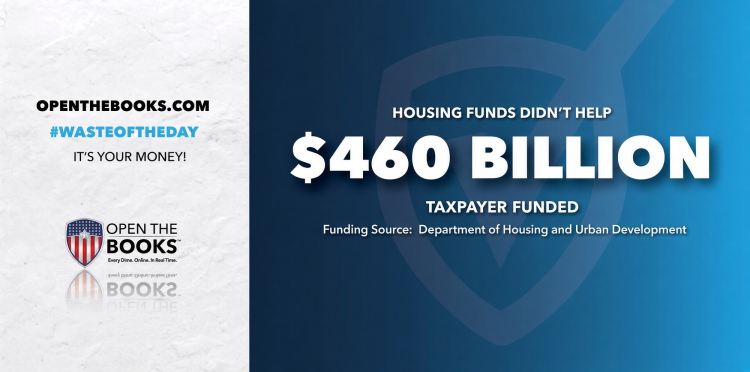
The Department of Housing and Urban Development spent $460 billion funding its 18 largest affordable housing and homelessness programs over a decade, but a new Open the Books review found the spending didn’t help reduce housing prices.
Key facts: For each of the 50 states, Open the Books measured the “affordability gap” — how much the price of an average home grew compared to how much income grew.
Idaho had the worst gap. Income grew 68% from 2015 to 2024, but the price of a house grew 151%. Florida, Nevada and Tennessee also had some of the worst gaps. Those are all states that saw increased migration during the Covid-19 pandemic.
Housing prices grew faster than income in every state. In 14 states, the price grew at least twice as fast as income.
Crucially, states that received the most federal housing subsidies were no more likely to be able to keep the price of a new home from growing rapidly. Massachusetts, which received almost $4,000 in subsidies per resident in 2024, had an almost identical affordability gap as states that received $500 per person.
There was also no measurable difference between red states and blue states, or between large and small states.
A 20% down payment is becoming more difficult to afford. Assuming a family saves 10% of its pre-tax income every year, it would take a family in Maine 25 years to afford a down payment. Even in Alaska, where down payments are the most affordable, it would take nine years.
Open the Books’ analysis does not show that HUD spending causes housing prices to rise. Rather, there are scores of other factors that affect prices and that can be addressed at the legislative level without spending taxpayer money. Zoning, permitting timelines, regulatory costs, fees, and restrictions that constrain supply.
Policymakers may also need to demand positive impacts from existing programs before simply appropriating more money. California spent $24 billion over five years addressing homelessness, but the state was unable to collect accurate data showing whether the spending had any effect.
Summary: Before Washington extends housing subsidies, taxpayers deserve proof that existing programs are actually making housing easier to afford.
The #WasteOfTheDay is brought to you by the forensic auditors at OpenTheBooks.com.
