


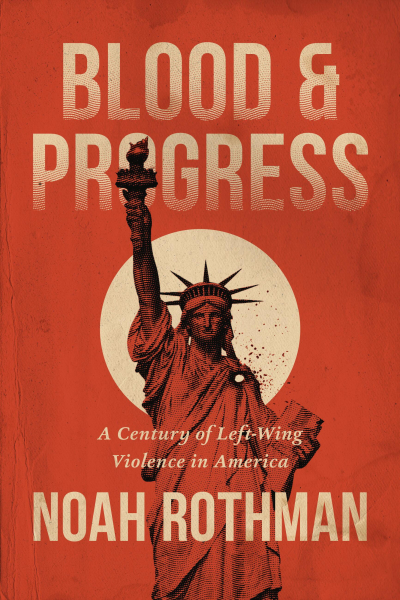
In only the last several years, corporate CEOs and conservative influencers have been killed in brazen attacks. Republican justices, presidents, and their staffs have been marked for threats, assaults, and even death. Small-cell terrorist organizations have executed sophisticated attacks on law enforcement. And much of it has been excused, even sometimes encouraged, by an intellectual ecosystem on the left that is, even now, incubating more political violence. In "Blood & Progress," from which this excerpt is drawn, the National Review’s Noah Rothman documents how and why left-wing violence has erupted in America for more than a century and reveals how very forces that celebrate it also work to deny it exists at all.
By Noah Rothman
Brian Thompson got up before the sun on December 4, 2024, jaunting on that brisk Manhattan morning from his Marriott hotel room to the 54th Street Hilton for United Healthcare’s annual investors’ group meeting. He had every reason to expect a busy day. With Medicaid Advantage enrollments spiking and new classes of drugs like GLP-1s, a medication that was conceived to manage diabetes but turned out to have near-miraculous weight loss applications, Thompson’s industry—and his firm, in particular—were looking forward to exciting years ahead.
Thompson never made it to the Hilton. As he approached the hotel’s entrance, a masked man approached him from behind, produced a Glock-style gun with 3D-printed components and a silencer, and shot him in the back. Thompson stumbled and collapsed onto the sidewalk, turning briefly to face his assailant before helplessly crawling away. His murderer cleared a jammed bullet from the chamber, walked silently up to his target, and fired two more bullets into Thompson, killing him. He was fifty years old.
With professional precision, the assassin sped off on an e-bike and disappeared, leading law enforcement on a multi-day manhunt culminating in the suspect’s capture outside an Altoona, Pennsylvania, McDonald’s nearly a week later. Thompson’s killer was, by all accounts, a depraved young man whose writings betray the disordered thinking that’s typical among people who murder complete strangers. In covering the shooting, however, national media outlets took their cues not from the victim’s aggrieved family and colleagues. Instead, they looked to the demented musings that pass for insight on social media.
In that cloistered environment, a consensus formed around the notion that the killer had struck a righteous blow against capitalism. With that, the press set out to attribute a hard but virtuous logic to the assassin’s actions.
Thompson’s killing ignited “a public display of Americans’ pent-up anger at the nation’s complex health insurance industry,” CNN reported. The “blatant lack of sympathy” from the ghouls who populate online forums notwithstanding, New York Times journalists observed that the activists making a spectacle of themselves “highlighted the anger and frustration over the state of health care in America.” The shooting “is surfacing the public’s deep frustration with the health insurance industry,” CBS News explained as it tried to spark the very national conversation the shooter hoped to force on us when he stole Thompson’s life.
Collectively, the press forgot everything it knew about the incentives that inspire copycat killers, all before the assassin’s identity was even known. Indeed, to sustain the elaborate backstory the left crafted for this killer, he had to be an abstraction.
The effort to make Thompson’s murderer into a hero became more complicated after he was identified, arrested, and charged. Luigi Mangione didn’t fit the role. This righteous avenger of the injustices meted out by the rapacious capitalist enterprise was, in fact, the scion of wealth, a privileged, overeducated wastrel whose chronic back problems were not United Healthcare’s concern because another insurer covered him. Mangione’s victim, by contrast, grew up the son of an Iowa grain elevator operator. Thompson worked his way up to the C-suite through the ranks to become an industry captain, a duty he balanced along with his roles as a fixture in his community, a husband, and a father of two boys.
It is a testament to the power of motivated reasoning that these confounding details did not dampen the left’s enthusiasm for this act of human sacrifice. Mangione’s visage was blasphemously etched onto prayer candles. Musical artists celebrated him at well-attended concert venues. The mere mention of his name produced a round of screaming cheers from Saturday Night Live’s audience. The words he scratched onto shell casings recovered at the scene of Thompson’s death—“delay,” “deny,” and “depose”—were featured prominently on in-demand merchandise. It wasn’t until the din of the public’s outrage could be heard above the sound of the cash register’s cha-ching that the e-commerce giant Shein took down an artificial intelligence-generated image of Mangione as a fashion model peddling floral shirts to teenagers.
Progressive lawmakers sought to co-opt this emerging sensation to burnish their own political brands. In the process, they revealed that this macabre display was not really about Mangione, Thompson, or the healthcare industry at all. More probably, this killing allowed them to vent all their barely suppressed dissatisfaction with the nation that had rejected their party in that November’s elections.
“You don’t kill people. It’s abhorrent. I condemn it wholeheartedly,” Senator Bernie Sanders told Jacobin magazine. “But,” he continued, betraying the perfunctory nature of everything that preceded the conjunction, “what it did show online is that many, many people are furious at the health insurance companies,” presumably for making a profit in a sector that should run on altruism alone. And Sanders was not just talking about health care. “The campaign finance system is broken, the health care system is broken, the housing system is broken, the education system is broken,” he continued. “It is broken.”
That pregnant “but” featured prominently in efforts by other Democrats to milk some political advantage from Thompson’s execution. “Violence is never the answer,” Senator Elizabeth Warren mused. “But,” she inserted, “people can only be pushed so far” and will “start to take matters into their own hands” when the political system doesn’t cater to their demands.
“This is not to say that an act of violence is justified,” Congresswoman Alexandria Ocasio-Cortez intoned with superficial solemnity. “But,” she added, “they need to understand that people interpret, and feel, and experience denied claims as an act of violence against them.” Senator Chris Murphy wouldn’t condone violence. “But,” he reflected, “we need to listen to what people are feeling.” The anger and hurt Thompson’s murder exposed must be “matched by the anger over the thousands of people who die, often anonymous deaths every single day at this country at the hands of a health care industry that mostly doesn’t give a shit about people and only cares about profits.”
These Democrats weren’t justifying violence, you see. They were merely whiteboarding rationales that might establish the utility of targeted assassinations and help make sense of the demonic energy Mangione’s bloodletting had unleashed. The idea to which they lent thoughtless credence is a simple one: Brian Thompson was shot multiple times at point-blank range in an act of self-defense against an unjust system and all its malevolent works. His death should be mourned, but not more than the environmental conditions that rendered his assassination inevitable, even desirable.
In a perverse 2025 CNN “documentary” largely about the growing threat posed by the violent right, reporter Donie O’Sullivan abandoned all good taste and sound judgment when he handed his platform over to journalist Taylor Lorenz, a hypochondriacal provocateur who once fantasized aloud about President Joe Biden’s death, to lecture conservatives about their blind spots.
In the Emmy-nominated documentary, Lorenz deemed it “hilarious” that anyone would go “clutching their pearls” over the death cult emerging around Mangione. “This is the United States of America,” she said through a permanent smile, “as if we don’t lionize criminals.” Thompson’s killer, she said with the legitimacy conveyed by CNN’s imprimatur, is a “man who’s a revolutionary, who’s famous, who’s handsome, who’s young, who’s smart,” she gushed. “He’s a person who seems like this morally good man, which is hard to find.” O’Sullivan didn’t recoil at the depravity that was staring him in the face. Rather, he laughed, and she laughed, too.
“Jokes about Thompson’s death have gone viral on virtually every social-media platform, and they have not stopped in the week since the shooting,” The Atlantic’s Ali Berland reported. “Mangione’s act and the response demarcate a new moment, one in which acts of political violence are no longer confined to extremists with fringe views but widely accepted.”
Berland bravely locates the origins of this degeneracy in the popularization of a crass culture on the left in which “jokes about ‘eat the rich,’ guillotines, and class war” became standard fare. Far less bravely, Berland also justified this bloodlust as an inevitable expression of youthful economic anxiety. Indeed, her editors branded the phenomenon she described “normie extremism,” but there’s nothing normal about it.
“This country was built on violence. We’re a very violent country,” The View co-host Sunny Hostin mused. She strained visibly, not to avoid justifying Thompson’s murder but to calibrate her support for his carnage to avoid offending the federal regulators and ABC network’s brass. “And so, I’m not, unfortunately, surprised people are celebrating the use of violence. I’m not surprised that this young man thought that change could be accomplished through violence.” After all, she brooded, so many Americans are saying that “violence is justified right now.”
If only Hostin were wrong about that. Far too many Americans across the political spectrum are acclimating themselves to a baseline level of political violence in the United States, in part because that is what we’ve been living with. By some estimates, we’re experiencing the most incidents of domestic political terrorism this country has seen in the last half-century.
Excerpted from "Blood and Progress" by Noah Rothman (Copyright 2026). Used with permission from Center Street, a division of Hachette Book Group, Inc.
