


BLUE MOUNDS, Wisc. – Ridglan Farms, a breeder of beagles for scientific experiments, has withstood attacks from the animal rights movement for years. Activists have broken into its buildings to document the conditions inside them, rescued some dogs, and pushed Wisconsin authorities to cite the company for animal abuse.
On April 30, Ridglan finally buckled to the public pressure, handing the movement against animal testing one of its biggest triumphs. Big Dog Rescue and the Center for a Humane Economy announced that the groups reached an agreement to purchase 1,500 beagles for an undisclosed amount of money. The dogs are being adopted out to families across the country; the remaining 500 may also be freed at a later date.

The hard-won concession was made possible by an unlikely and uncoordinated alliance of advocates from the left and right. While left-leaning animal rights groups like Direct Action Everywhere have carried out past break-in efforts to rescue the dogs, MAGA luminaries Laura Loomer and Lara Trump – President Trump’s daughter-in-law and a board member of Big Dog Rescue – waged a highly visible pressure campaign on the company and the animal testing industry. At a time when partisan divisions continue to widen in the nation, one area of common ground seems to be animal welfare.
“You do have moments that define the progress of a cause,” Wayne Pacelle, president of the Center for a Humane Economy, said in an interview. “This may be an inflection point.”
The movement has scored other wins recently. In 2022, the FDA Modernization Act 2.0 eliminated an agency animal testing mandate that had been in place for the better part of a century. White Coat Waste, a group that advocates against government-funded animal experimentation, was instrumental in defunding dog and cat testing at the Veterans Administration, as well as the departments of defense and agriculture.
But animal testing remains a huge industry. U.S. scientists experiment on tens of millions of animals a year, according to an estimate by former University of California veterinarian Larry Carbone. The precise number is unknown, as most of them are fish, mice, and birds, which are exempt from animal welfare regulations and reporting requirements. About 62,000 dogs and cats are used in experiments annually, according to Humane World for Animals.

Naomi Charalambakis, a spokesperson at Americans for Medical Progress, an animal-testing advocacy group, says the practice remains necessary for scientific advancement and medical breakthroughs. She pointed to a new gene therapy for hearing loss, a personalized CRISPR gene therapy that saved the life of a baby, and a new injectable HIV-prevention drug as innovations that would have been impossible without animal testing. The practice was also used to develop the polio vaccine and the heart pacemaker.
“If we banned animal testing, patients who need new drug treatments would be the ones to lose out,” said Charalambakis, who has a doctorate degree in anatomical science and neurobiology.
Animal rights activists and some researchers disagree, arguing that the benefits to scientific knowledge do not justify the suffering animals endure and that technological advances offer alternatives that yield better results.
Dr. Mihael H. Polymeropoulos, co-founder of Vanda Pharmaceuticals and a critic of animal testing, says his company’s examination into the role of animal testing found that it’s not helpful in the development of treatments. Rather, it continues because of “bureaucratic inertia.”
“For many prolific scientists, doing anything but animal testing is actually throwing their career away,” he said. “All of a sudden, you have to learn a new approach. You’re not going to get the government grants, you’re not going to survive.”
The animal experimentation industry is almost entirely government-financed, mostly from the National Institutes of Health, which has close to a $50 billion a year budget. Between 40% and 50% of its grants go to experiments involving animal subjects, according to the NIH.
Why Scientists Prefer Beagles
Ridglan, one of two major U.S. breeders that sources beagles to government-funded laboratories, was hit in 2025 with hundreds of citations from the state of Wisconsin for violating animal welfare laws. In order to avoid criminal prosecution, Ridglan agreed to a settlement that suspended its license to breed and sell beagles, beginning in July, though it can still conduct experiments in-house. The facility’s manager had his veterinarian’s license revoked for delegating eye surgeries on dogs without anesthesia – and done by employees without veterinary licenses.
Although dogs are covered by the federal Animal Welfare Act, the rules allow for conditions activists consider inhumane. A dog’s cage is required to be only six inches taller and longer than the dog itself. If the cage is twice as big as the dog, then the animal is exempted from any exercise requirement, which means they may never be let out of their cage. Guidelines for minimizing pain for research dogs allow for model designs in which relief is deliberately withheld.
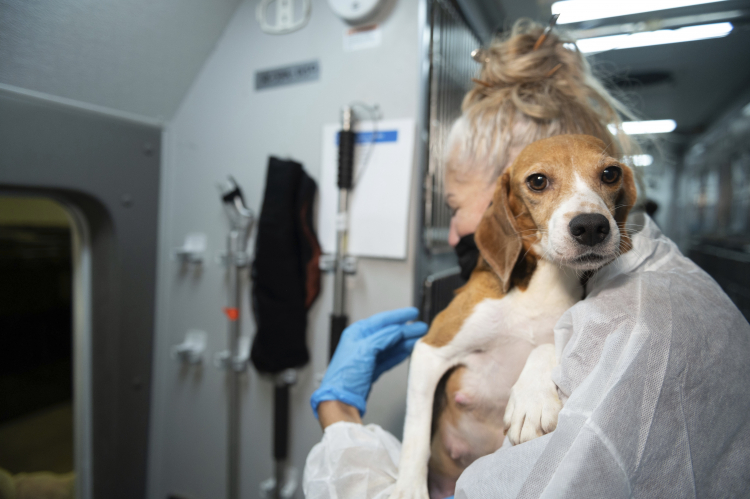
Stacy Lopresti-Goodman, a psychology professor and a director with the Animal Legal Defense Fund who provided expert testimony in a lawsuit against Ridglan, says that suffering is the norm for such laboratory beagles. “The behaviors visible in publicly available footage of beagles inside Ridglan – such as circling, repetitive pacing, and depressed hunched postures – are not normal,” she told RCI in an email. “Decades of research reinforce that these abnormal behaviors are clear indicators of compromised well-being and severe psychological distress.”
Ridglan didn’t respond to a request to respond to this criticism.
Beagles are the breed of choice for scientific experimentation for the same reason people love them as pets: they’re small, docile, and eager to please human beings, including lab technicians. Even in the worst of circumstances, they’re unlikely to do much more than bark, and for that inconvenience, Ridglan will sever their vocal cords for an extra fee.
Ridglan rears breeder beagles to produce litters of puppies who spend their days in small cages indoors until they’re sold to a lab. There they live out the rest of their short lives in another cage, being force-fed toxins, injected with viruses, and subjected to exotic surgical procedures before being killed and dissected.
White Coat Waste tracked Ridglan beagles to one ongoing experiment at the University of Missouri. Tick containment chambers are glued to puppies so that mutant ticks can feed on them for a week, with no pain relief medication provided to the dogs. Ridglan dogs are also currently being used in respiratory safety drug toxicity tests.
Pressure Campaign
Last year, around the time Ridglan agreed to its settlement with Wisconsin, negotiations began between the company and the Center for a Humane Economy to release the dogs for adoption. Ridglan wanted $3 million, according to Aidan Kankyoku, one of the leaders of the open rescue campaign. The offer on the table was closer to $150,000. The talks stalled.
Then a grassroots group called the Coalition to Save the Ridglan Dogs, led by Wayne Hsiung, co-founder of Direct Action Everywhere, began organizing an “open rescue” at Ridglan. The often-used practice among animal rights activists involves breaking into facilities that hold animals without concealing their identity and broadcasting the action to the public. The purpose of the tactic is to send the message that activists don’t see themselves as criminals for a cause they believe has widespread public support.

On a March morning, activists used a crowbar to bust into one of Ridglan’s six buildings housing beagles and carried out dozens of dogs that were put up for adoption. The images from the open rescue went viral after online celebrities like Barstool Sports’ Dave Portnoy shared them.
The success of the event encouraged activists to organize a bigger April break-in at Ridglan to free the remaining dogs. The complicated plan involved a combination of covert action and mass mobilization. For months, activists surveyed the site with drones and studied the images with the help of structural engineers. They planned to strip chain link fences with wire cutters, cut through reinforced doors with angle grinders, and pry them open with firefighter tools, allowing hundreds of people to stream through the entry points and carry out beagles.
The activists publicly announced their audacious plan as a way to recruit participants at scale. But the decision to go public also gave Ridglan and law enforcement agencies time to prepare a response.
Activists trained for the breach, practicing with saws and firefighting tools in the garage of a rented home. Jason Mills, a former Mixed Martial Arts cage fighter who makes fuel tanks for a living, led the training on breaking through doors with power tools. Ridglan had dug manure-filled trenches and erected a wall of hay bales around the property to impede entry. So in a field outside a barn, activists practiced rolling hay bales and scaling them with hooks.
While many of the activists had conducted open rescues of pigs, cows, chickens, ducks, and other animals from factory farms and slaughterhouses, the campaign against Ridglan drew from the much wider swath of Americans who care more about dogs.
“I’m standing there with people who don’t have the same views as I do on other things, but we can all agree on” the need to rescue dogs, said Chuck Haasch, a 61-year-old retired machinist from Wisconsin who leans right politically. Haasch and his wife equipped their three-car garage at home with enough kennels to foster dozens of beagles. His wife put a bed in the garage so she could sleep with them and provide comfort.
Richard Kozicki, a 67-year-old retired pilot from South Carolina, said he joined the open rescue after his beloved beagle died in February. With tears welling up in his eyes, he says he came to the action in her honor. “I’ve never done activism in my life,” he said. “The majority of people in the United States are animal lovers and will not tolerate this.”
Best Laid Plans
In April, soon after the hundreds of activists gathered outside of Ridglan’s protective fencing, the plan to breach the facility ran into an unanticipated overwhelming police presence of dozens of officers.
“I made it through a couple of shackles on the fence, and I was immediately maced from three directions, at short range,” said Mills, who helped lead the breaching action. Mills was also shot by rubber bullets and pepper balls.
A handful of others who got through the fence were also maced by police and arrested. “They were on the ground, submitting to the police, and the police blasted them right in the eyeballs with pepper spray,” said Haasch, who observed the police behavior.
“They were laughing like it was the best time they ever had,” said Mills, adding that the police issued no warnings to protesters before tear-gassing them. “No communication, no escalation of force. Zero to ten.”
The Dane County Sheriff’s Office did not respond to requests for comment.
Less than half an hour after the open rescue began, it was clear that it had failed. The activists surrounding the facility dispersed as police lobbed tear gas at them every few minutes. No beagles were saved that day.
In a Zoom call hours after the failed open rescue, some of the activists who were not involved in the planning expressed astonishment at the leaders’ mistaken assumptions. The organizers had anticipated relative restraint by the police, negotiations with the company, and perhaps only the ringleaders facing arrest. But the April action was big, drawing more than a thousand activists, and the police knew all about it, thanks to the publicity.
“We were fools,” Kankyoku admitted on a Zoom call.
Bipartisan Movement

The activists at Ridglan that April day weren’t the only ones pushing to shut the company. In recent years, conservative animal lovers and right-leaning politicians, such as Republican Sens. Rand Paul and Joni Ernst, and former congresswoman Marjorie Taylor Greene, have enthusiastically embraced the cause. This is partly due to the notoriety on the right of Anthony Fauci, who formerly led the National Institute of Allergy and Infectious Diseases, the main funder of the animal testing industry.
“For over half a century, he personally conducted deadly primate experiments and built a multi-billion-dollar NIH empire that did more to entrench, proliferate, and prolong animal testing than anyone else,” said White Coat Waste Project founder Anthony Belotti, who has spent years organizing conservatives against government-sponsored animal testing. (Fauci has said that the activists making these charges are anti-science and don’t realize or ignore the benefits of animal testing to the development of life-saving medical treatments.)
Big Dog Rescue founder Lauree Simmons said her group had gotten nowhere with the federal government until the Trump administration. Former Attorney General Pam Bondi convened an animal welfare summit attended by U.S. attorneys, federal marshals, and officials from the Department of Agriculture. NIH has pledged to move away from animal testing; the FDA has established a roadmap to reduce it; and the Department of War, under Secretary Pete Hegseth, ended the practice at the urging of Laura Loomer.

Lara Trump, who has used her platform as a Fox News host to repeatedly address animal welfare issues, may have had a hand in the release of the beagles at Ridglan. Amid the open rescue actions at Ridglan, her group, Big Dog Rescue, joined the negotiations for the release of the dogs. In an Instagram post on the night of the failed open rescue, Trump said the facility should take an offer of $1 million in exchange for the animals. The final price to free the dogs wasn’t publicly disclosed, and RCI was unable to reach Lara Trump for comment.
Activists don’t know if the break-ins, bad press, deal money, or a combination of them, convinced Ridglan to release the dogs. Whatever the cause, the move is part of a shift away from animal testing, said Tami Drake of the Center for a Humane Economy.
“If you look at the companies that breed lab beagles, they’re dwindling,” she said.
