


Even as many scholars and pundits deny the differences between the sexes and vastly expand the concept of gender, society is increasingly dividing along these clear and simple lines.
Mountains of data and broad-based studies show that men and women increasingly inhabit separate psychological, relational, and civic universes that interpret adulthood, authority, intimacy, and obligation in profoundly different ways.
The most visible sign of this cleaving of the sexes is the steady decline of marriage and childbearing. The share of U.S. adults ages 25–54 without partners rose from 29% in 1990 to 38% in 2019. In 2021, one-quarter of U.S. 40-year-olds had never married. Even as fertility rates continue to fall, the percentage of children born out of wedlock and living with one parent has risen.
This physical separation is mirrored in our politics, where the gender divide is now a prime determinant of party affiliation – especially among the young. The fierce tribal divide in America is not merely a clash of Democrats and Republicans, but also a contest between the very different visions and priorities of women and men. The growing antagonism between the parties increasingly reflects the distance between the sexes.
Once the central cooperative engine of civilizational continuity, the relationship between men and women is increasingly seen as a zone of tension, risk, negotiation, and withdrawal.
Some of this is due to the battle women have had to fight for greater freedom in the last 60 years, which, of course, has had many positive effects. It has not just expanded women’s opportunities in education and the workplace. It has also allowed women to imprint their values on a patriarchal culture that was long ruled by men – but this time increasingly for their own benefit.
As much as “women’s liberation,” as it was originally known, has been shaped by modern ideas about gender and selfhood, it has also given greater expression to enduring differences between the sexes. It is generally understood that men tend to be more aggressive, competitive, and individualistic, while women tend to place more value on cooperation, compassion, and safety. Various studies – especially those in egalitarian-minded societies of Scandinavia – suggest that the movement toward gender equality has allowed differences to flourish. As Swedish researcher Agneta Herlitz observed: “Some sex differences in personality, negative emotions and certain cognitive functions are greater in countries with a higher standard of living.”
A RealClearInvestigations analysis of this ongoing transformation suggests growing challenges not only for the United States but also for many Western and Asian nations, where this cleaving of the sexes is occurring. It’s undermining the traditional basis for stable families and communities and will have enormous implications for future demography, politics, and social stability.
The Rise of Feminization
For much of the 20th century, despite real injustices and constraints, men and women operated under a shared cultural narrative: education, vocation, marriage, children, community. These stages were not merely social expectations; they represented a shared roadmap of adulthood. In the most general sense, women had limited options beyond homemaking and childrearing; men were free to pursue individual goals, including employment. It wasn’t fair, but one could not miss its coherence. That coherence has evaporated and has been replaced by a more individualistic arrangement with less emphasis on family and community.
The feminist liberation that rightly dismantled oppression also disrupted, sometimes unintentionally, the traditional paradigm by adopting a post-familial ethos. For some women, being tied to a man and children became associated with weakness; relational obligation to husbands and children was often cast as a constraint. Longtime radical feminist Sheila Cronan, a leader of the National Organization for Women, declared that “since marriage constitutes slavery for women… Freedom for women cannot be won without the abolition of marriage.” Historian Linda Gordon argued that the “break-up of families” is part of “an objectively revolutionary process.”
These views echoed Marxist doctrine long embraced on the left. Both Karl Marx and Friedrich Engels dismissed marriage as tied to the “mode of production,” seeing the monogamous, male-dominated family as doomed by the end of capitalism. Engels associated “marital bliss” with “leaden boredom.” The influence of these views can be heard in the Black Lives Matter movement’s calls to “disrupt the Western-prescribed nuclear family structure,” and in the writing of the nominally conservative columnist David Brooks, whose 2020 article in The Atlantic was titled “The Nuclear Family Was a Mistake.”
These ideas have flourished, in part because of broader changes that include globalization and free trade that eroded employment stability in the West; consumer culture that exalted individual autonomy over family ties; technological changes, especially the rise of social media and ubiquity of pornography, that further loosened interpersonal ties by enabling people to live in relative isolation. As San Diego State psychologist Jean Twenge has argued, young adults today are “more likely to embrace unrestrained self-expression and prioritize autonomy in personal behavior” compared to older Americans.
Each change was individually defensible. Collectively, they rewired the moral operating system of modern society. Even many women who reject the feminist label were taught that dependence equals danger. Men were told that their instincts are suspect. Community gave way to individualism. Obligation gave way to preference. Tradition gave way to self-expression. The hidden lesson: You are safest when you need no one.
Women’s mass entry into the American workforce, beginning in the 1960s, expanded their economic independence by reducing their economic dependence on men. The simultaneous rise of the welfare state offered enhanced benefits to single mothers. This trend may accelerate in the years ahead as women’s dominance grows in higher education – and in a service economy that increasingly prioritizes the soft skills, at which women tend to excel, rather than more physically challenging jobs where men have an edge.
Today, 47% of women have college degrees, compared to just 37% of men – a gap that has widened dramatically. In 1995, white women and men had equal rates of college completion at 29%; by 2024, 52% of white women held degrees compared to 42% of white men. The disparity is even more pronounced among black Americans.
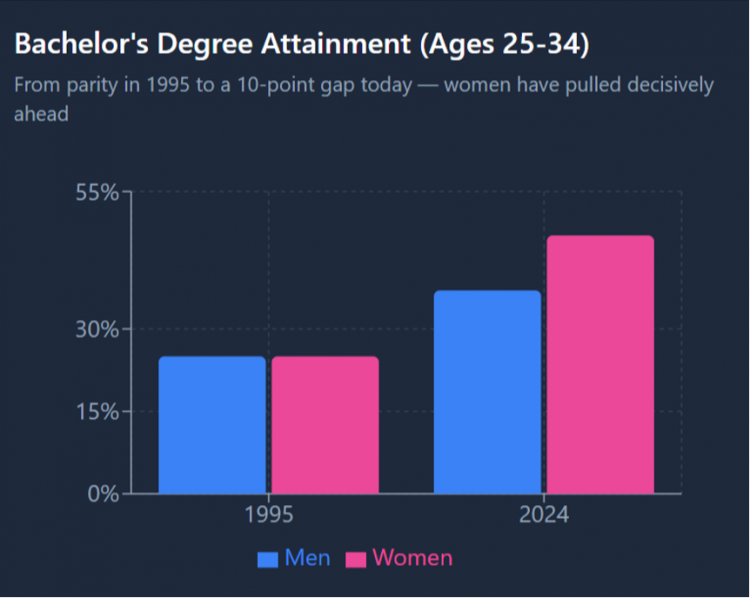
Women have not yet reached parity in corporate C-suites and the highest levels of government, but their educational edge suggests future predominance. Law schools became majority female in 2016; law firm associates in 2023; medical schools in 2019; the New York Times staff in 2018. As Helen Andrews recently argued in her essay “The Great Femininization,” these achievements have elevated female characteristics – empathy, orientation toward groups – over historical male attachment to such things as order, courage, and willingness to rebel.
In the process, family, once the lodestone of identity, is being replaced by a new focus on gender. Although many rightly celebrate these changes as overdue and see female domination as a net plus, they come with costs for both sexes. Under what Mary Eberstadt calls “the great scattering,” as she defines the last 60 years, we have created “a communal dislocation” that threatens the future of sex relations and society as a whole.
The Demise of Intimacy
At least since author Tom Wolfe dubbed the 1970s the “Me Decade,” the self has become ever more primary. Relationships are evaluated not by commitment or endurance but by their capacity to affirm identity, a natural product of a diminished tie to family. Children, once culturally assumed, now appear as optional additions to an already curated self.
As their economic and social dominance has slipped away, men increasingly feel estranged. Young men, particularly on campuses, are castigated as toxic, aggressive, and born misogynists. These prejudices, while sometimes reflecting a chauvinistic reality, have become common even in the sanctity of psychological practices. In elite literary circles, many male writers are tossed into the cornfield, reflecting a media bias about the dangers of masculinity.
Many young women are showing their own dismay with men. Hence the rise of “heteropessimism” which a 2024 article in the New York Times described as “an explosion of young women who say they are deleting dating apps; female celebrities (among others) who have taken vows of celibacy or identify as “self-partnered”; divorce memoirs by older millennial and Gen X women expressing profound disillusionment with heterosexual marriage; and trends like “boysober,” which preaches the virtues of “decentering men” to focus on self-improvement and platonic relationships.”
In a related phenomenon, today more than 28% of all young women, notes Gallup, identify as LGBTQ, almost three times that for young men.

An unwillingness to tolerate different political views cuts across the left-right spectrum, but is especially pronounced among the whiter, better-educated, and most progressive segments of the electorate, notes a survey done for The Atlantic. Female college students, particularly those on the left, display markedly higher levels of ideological intolerance than their male peers and are significantly more likely to refuse to date someone with opposing political views. This pattern extends well beyond campus. A 2020 YouGov poll found that nearly half of Americans say they would feel at least somewhat upset if their child married someone from the other political party, a dramatic shift from the negligible concern recorded in mid-20th-century surveys. Pew likewise reports that about seven in 10 Democrats looking for a relationship say they would not consider dating a Trump voter, a stance especially common among younger women. The result is a kind of relational toxin: politics now short-circuits attraction, friendship, and even the possibility of basic trust across differences.
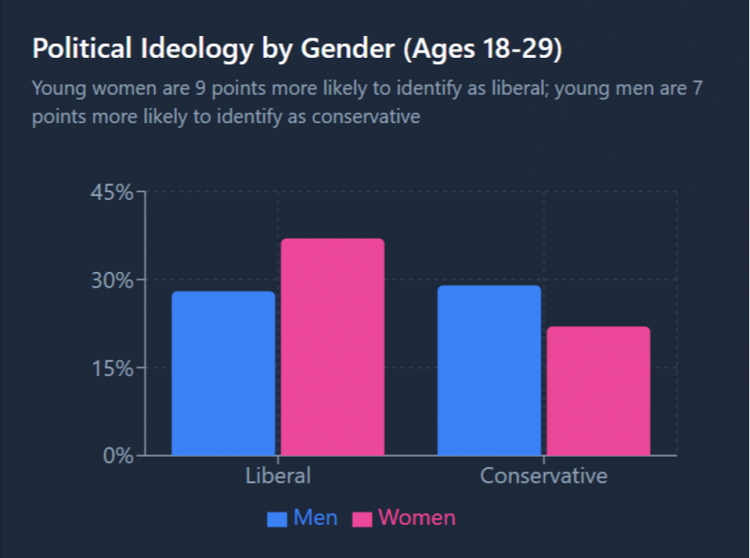
This is more than conventional left–right polarization. It is gendered moral architecture, where progressive women are the driving force toward cancel culture and the imposition of speech codes. During the highly visible “No Kings” protests – rhetorically cast as universal uprisings against “authoritarianism” exemplified by President Trump – it was women who predominated, according to research from American University scholars. (The fact that many men also participated underscores that sex differences are not absolute, but on a continuum.) Psychotherapist Jonathan Alpert described these protests as “a kind of group therapy playing out in the streets” – a snapshot of an era when emotional catharsis and civic activism have begun to blur.
In contrast, men’s plight increasingly leads them in the opposite direction. The politics embraced primarily by female voters, such as strong climate regulation and support for mass immigration, is widely perceived by many men as a direct threat to their cultural and economic roles, notes Frank Furedi in his forthcoming book, “In Defense of Populism.”
In the U.S., young male voters increasingly support Donald Trump. Long oriented to blue-collar jobs, many young men also face an environment with little opportunity for high-paid work, partly a result of the globalization of markets, and many simply drop out of the workforce. The share of U.S.-born, working-age (16 to 64) men not in the labor force is nearly twice as high as in 1960, rising from 11.3% to 21.7%. If the same share of U.S.-born men were in the labor force in 2025 as in 1960, there would be 8.9 million more of them in the labor force.
This alienation extends to politics, institutional distrust, and seems to correlate with lower levels of contact even with peers. Some drift rightward; others retreat from civic life entirely. The Spectator’s examination of whether education systems are radicalizing young men reveals how ideological hostility, moral suspicion, and institutional neglect contribute to a growing sense that young men are culturally dispensable.
Thus, their increasing support of Trump, the prototypical alpha male, is unsurprising. This is also evident in the racist and often misogynistic chat on young Republican websites. Some have also drifted into rabidly antisemitic groups such as the Proud Boys. This is not just an American phenomenon. European men under 30 increasingly embrace the traditionalist right, for example, backing the AFD in Germany at roughly twice the rate of women, a pattern common across the continent.
Mistrust and Estrangement
This rupture between the sexes is made more pronounced by the digital environment in which it unfolds. Technology has not merely accompanied the gender divide; it has engineered and accelerated it.
As Professor Twenge notes, the online world represents “the ultimate tradeoff,” giving us “instant communication, unrivaled convenience” as well as a way to reduce drudgery. Yet it is also making us “more isolated from each other,” more polarized, and creates “a mental health crisis among teens and young adults.”
Algorithms do not offer neutral information; they curate identity. A 2020 meta-analysis published in Computers in Human Behavior found that women are significantly more prone to social media addiction, while men show higher levels of internet gaming disorder. According to Yale’s Women and Addictive Disorders Core, women are “more sensitive to social signals” and “put a higher value on relationships,” making them more susceptible to the validation loops of social media platforms. Girls are typically first exposed to social media at younger ages than boys and spend more time on these platforms than boys.
Young men migrate to equally insular spaces defined by competitive masculinity, grievance politics, and performative self-mastery. The language is often harsh, sometimes corrosive, but it reflects a deeper hunger: the search for structure, coherence, and recognition. Studies confirm that males are “attracted to the competitive structures provided by online gaming.”
Crucially, neither digital environment brings men and women closer to understanding one another. Instead, each learns to fear caricatures of the other. She becomes predator or liability; he becomes oppressor or emotional threat. The algorithm favors the most polarizing content, ensuring that outrage outperforms nuance and suspicion outpaces empathy.
This is not simply social fragmentation. It is a systematic dismantling of the shared emotional grammar necessary for relational trust. Where previous generations encountered the opposite sex through physical proximity – schools, churches, civic life, mutual acquaintances – today’s youth often encounter each other through the lens of curated digital fragments. The rise of readily accessible pornography intensifies this interpersonal disconnect.
Intimacy, once grounded in interpersonal contact, now becomes filtered through technology and ideology. Attraction becomes negotiation. Trust becomes liability. And cooperation begins to feel like surrender.
All this could soon get worse, notes the social psychologist Jonathan Haidt, with the rise of AI. Mark Zuckerberg might herald the era of “AI friends” to replace the lost ones, but Haidt notes that ChatGPT admits that the way to weaken future generations would be “through slow, invisible corrosions of the human spirit, rather than obvious attacks.” This is already what was happening with the Internet, but digital power will be enhanced by new technologies like AI and the much-discussed metaverse, essentially an artificial experiential universe. The development of AI companions and even sex robots could further reduce the need for human concourse.
Decline of Marriage and Fertility
The consequence is not feminist empowerment or masculine renewal but mutual fragility, and something of a slide towards social nihilism. Marriage was never merely a private romantic institution. It was a structural mechanism that anchored individuals to long-term relational responsibility and, by extension, to civic life. It created a framework through which men and women cooperated across differences to build something greater than the self. This represents one of the most dramatic transformations in marriage patterns in human history.
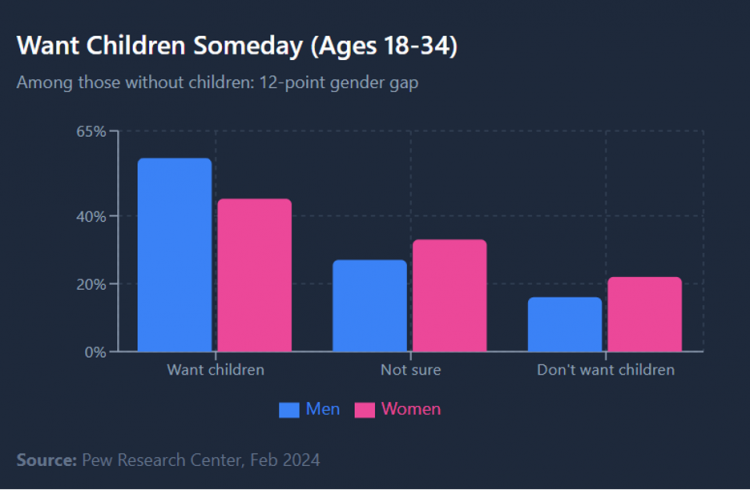
The decline of this institution suggests a troubling future for many young people, as marriage constitutes a key element for success, leading to higher incomes, less child poverty, and higher fertility rates. Marriage is increasingly an option embraced by the upper classes, a clear majority who are married, while barely a quarter of those at the bottom are wed. In 1964, only 7% of American children were born out of wedlock, compared to 40% today.
In economic terms, family breakdown fuels poverty. On average, even high school dropouts who are married have a far lower poverty rate than do single parents with several years of college.
The cleaving of the sexes will have long-term demographic implications. Today, romantic relationships are increasingly episodic, contingent, and transactional. Cohabitation rises, but without the symbolic permanence that historically encouraged sacrifice and endurance.
Research from the National Marriage Project and the Wheatley Institution has found that married women show a 54% likelihood of being in the highest satisfaction group. Significantly, only about 6% of permanent cohabitations remain intact at 10 years. Cohabiters often develop a “what if this doesn’t work out” mindset that undermines commitment, with higher rates of infidelity and conflict than married couples – patterns that hold even in European countries where cohabitation has been accepted for generations. The transformation of marriage into an optional lifestyle accessory rather than a foundational institution reflects the broader shift from continuity to self-optimization. Commitment now competes with autonomy – and autonomy often wins.
Without marriage, there is no clear alternative mechanism for ensuring intergenerational continuity. Children become risky propositions. The family ceases to function as a moral center; the lack of siblings also slows socialization within the family.
Eric Kaufmann’s 2025 essay “Feminism Against Fertility,” published in First Things, maps how leading strands of feminist ideology now frame motherhood and pregnancy as constraints rather than as generative responsibilities. In some quarters, there is hope that offspring can, as in Aldous Huxley’s dystopian classic “Brave New World,” be grown in vats, without actual mothers.
These trends are not only happening in America and Europe. In places like South Korea and Japan, men and women are becoming like separate races. In Japan, the harbinger of modern Asian demographics, one in four people in their 20s and 30s are virgins. Indeed, the Japanese even have a term – herbivores – for the passive, desexed generation of young men. Androgyny dominates the pop culture, with men seeming to be more like women. The situation is so bad that in Korea, there has been an attempt to spur dating with the unlikely sponsorship of the state.
The loss of intimacy leads to other predictable outcomes. The U.S. total fertility rate was above the 2.1 replacement level as recently as 2007. Now, it is just 1.62 children per woman over a lifetime. As marriage among people of child-bearing age has declined, the most common number of children born to an American woman aged 25-44 is now zero. A new Institute for Family Studies analysis of 2020 Census data found that one in six American women is now childless by the time they reach the end of their childbearing years, up from one in 10 in the 1970s.
Child-rearing and marriage are on the decline across Europe, including France. In South Korea, the fertility rate reached 0.72 in 2023 and 0.75 in 2024 – the lowest in the world despite government subsidies for those who have offspring.
In many circles, childbearing is often challenged as an interruption of autonomy. Irin Carmon’s 2025 book Unbearable: Five Women and the Perils of Pregnancy in America exemplifies this ambivalence. In promotional materials for the New York Times, Carmon wonders whether “talking honestly about what’s messy and painful and unfair about pregnancy and parenting can make choosing it seem almost absurd.”
Democracy and the Sexes
As intimate life fragments, civic commitment inevitably weakens. Citizens disconnected from stable relational networks exhibit lower levels of trust, participation, and shared sacrifice.
Single adults tend to engage less frequently or deeply in local institutions and exhibit weaker attachment to place. A national survey by Citizens & Scholars found that 33% of young adults aged 18-24 have no intention of participating civically, with the same proportion not engaged in any community activities.
Today, identity migrates toward temporary, affect-driven forms – online networks, political tribes, social causes – that provide emotional intensity but little stability. These forms of belonging are powerful but ephemeral. They rally outrage more effectively than cultivating patience. They mobilize commitment more rapidly than they sustain loyalty.
This has clear implications for democratic stability. Democracies depend not merely on laws and procedures, but on shared assumptions, habits, and goals. Those habits are cultivated in families, congregations, neighborhoods, and shared traditions. When these dissolve, ideological polarization fills the void. Politics has become therapeutic theater, not collective governance.
Beyond its moral and cultural consequences, the cleaving of the sexes carries profound economic and demographic implications – not only in the U.S. and the West but China and the rest of East Asia, where declining rates of marriage and fertility are among the lowest in the world.
As fertility rates fall below replacement, dependency ratios rise, public pension systems strain, labor shortages intensify, and generational burdens become unsustainable. Economic dynamism weakens. Innovation slows. Young people, notes economist Gary Becker, are critical to an innovative economy.
More subtly, the disappearance of stable family life erodes the invisible economic scaffolding once provided by informal kinship networks. The family historically served as a buffer against hardship, a source of care for the elderly, a moral training ground for children, and a stabilizing force against social volatility. As these functions weaken, the burden shifts either to the state or to no one at all. In either scenario, trust declines or resentment grows. The gender divide thus does not merely change how people love; it changes how they build, risk, invest, save, and imagine the future.
Creating a New Family Ethic
Given current trends, the feminist historian Stephanie Coontz has argued, we will need both “to invent new family traditions and find ways of reviving older community ones.” As yet, however, no beneficial alternative is on the horizon.
In the short run, progressives will benefit from the rising tide of childlessness – as it bequeaths more power to the state and allows adults to spend more of their incomes on themselves. It is no coincidence that urban centers that increasingly skew left, including New York, Los Angeles, and the Bay Area, have the fewest children. The majority of Manhattanites are childless and have never been married.
But in the long run, demographics will catch up with the largely progressive singles culture. After all, the childless leave no heirs. Maturity could prove a boon to traditionalists; some 1 million millennials become mothers every year. They may increasingly turn to the familial values of sacrifice and saving for the future, as well as looking for a home with enough space to raise children.
We can see this clearly already in geographic terms. Virtually all the states that are growing economically and demographically tend to be more religious, while those with low rates of religious engagement tend to have experienced slower growth. Married women have also shifted toward the right, and this has sparked a tide of new influencers who pitch a more traditionalist message online. Marriage, it turns out, makes women not only more conservative but perhaps happier as well.
As in the past, it is critical to create conditions that allow for a return to healthier sexual relations. One would be to promote homeownership, long a prerequisite for family formation and growth. In 1950, more than half of 30-year-olds were married and owned their home; by some estimates, it’s now barely one in eight.
If economic conditions for young people improve, we could see a resurgence of familial life. Despite media accounts that young people do not want to start families or own homes, most surveys show that the vast majority of Americans in their 30s want to replicate these foundations of middle-class life, notably single-family homes closely tied to fertility.
Even more critically, granting greater priority to the family requires a moral imagination capable of integrating autonomy with obligation, equality with continuity, and liberation with responsibility. It is also essential to our own happiness, as studies show consistently. Some 70% of adults are either happy with their current brood, want more, or still hope to have them; we should endeavor to make more of them an essential choice.
This is not a call for social regression but for a new realization that, as humans, we are not meant to be disassociated atoms but part of an organism that reproduces and passes on its values to the expected future. Autonomy and obligation must coexist. Equality and continuity must reinforce rather than cancel one another. Relationships must once again be valued as formative rather than restrictive. What’s at stake is moral survival.
Samuel J. Abrams is a professor of politics at Sarah Lawrence College and a senior fellow at the American Enterprise Institute.
Joel Kotkin is Presidential Fellow in Urban Futures at Chapman University and executive director of the Urban Reform Institute.
