


Joseph Cohen had worked for an organization in Britain devoted to encouraging Jewish-Muslim dialogue and combating antisemitism. But following Hamas’ Oct. 7, 2023, attack on Israeli civilians and then the bombing and destruction of Gaza, the rising tide of sometimes violent antisemitism made him feel he no longer belonged in his native land.
“I would rather be living in the nation where the police and the military are set up to do everything they can to prevent that,” he recently told the Jerusalem Post.

Cohen is one of a growing number of British Jews who feel less safe in the United Kingdom. Polls show antisemitic attitudes have been rising sharply in the U.K., their fear stoked by several high-profile attacks, including a deadly Yom Kippur assault on the Heaton Park synagogue in Manchester by a knife-wielding Syrian native.
A recent study found that 47% of British Jews now see antisemitism as a “very big” issue – up from just 11% in 2012. The Institute for Jewish Policy Research study also found that 32% of British Jews said they had personally experienced at least one antisemitic incident.
Nevertheless, few British Jews have followed Cohen’s lead in leaving the country. Although he feels safer in Israel, there is still more net migration to Britain from Israel. Even as a growing number of British Jews say it is getting harder to envision a future in their native land, they are engaging with Prime Minister Kier Starmer’s government to address physical attacks and hateful rhetoric. With wary optimism, they are developing strategies to help the government tackle widespread antisemitism both in Britain’s institutions and on its streets.
“‘Just keep your head down and don’t make a fuss and you know it’ll all blow over,’ has traditionally been a British, Jewish kind of stereotype,” said Adam Ma’anit, a member of the Board of Deputies of British Jews, whose 300 deputies are directly elected by the synagogues and communal organizations they represent. “Now I think people realize they actually can’t do that anymore. It’s not working for us.”
Ancient Scourge Strengthens
Antisemitism is an ancient scourge, but it has grown more intense since Israel launched a deeply controversial war in Gaza following the Oct. 7 slaughter of Israelis.
U.K. Jewish advocacy charity Community Security Trust (CST) recorded more than 1,500 antisemitic incidents in the first half of 2025, the second highest on record following the peak in 2024. U.K. government data recorded 1,715 anti-Jewish incidents from March 2024-2025. Data from London’s Metropolitan Police indicates attacks on Jews have accounted for 40% of all anti-religious hate crimes in the last year.

Some antisemitic incidents have turned into scandals. BBC head Tim Davie resigned in part because of revelations that the state-owned broadcaster had failed to disclose the Hamas ties of a Gaza war documentarian. A high-profile November soccer match in Birmingham between Israel’s Maccabi Tel Aviv and Aston Villa drew controversy when a local security body prohibited ticket sales to the visiting team’s fans, citing security concerns. Starmer’s government intervened to say visiting team fans should be allowed to attend and would be protected, but the Israeli team declined the offer as too little, too late. Most recently, a video leaked of a speaker at University College London resurrecting the medieval antisemitic blood libel trope in a campus talk.
These incidents reflect a global problem. As RCI has previously reported, a January study from the World Zionist Organization and the Jewish Agency for Israel found a 340% increase in total antisemitic incidents globally in 2024 compared to 2022. This included a 562% rise in Canada, a 350% rise in France, and a 288% rise in the United States.
In response to the Manchester synagogue attack, Starmer declared an investment of £10 million to improve security at Jewish sites. But it remains to be seen if his government will heed calls from British Jews to pursue a whole-of-government response that they say is hamstrung by political correctness.
A 2024 government report found London’s Met Police was failing to investigate crimes and to adequately manage offenders. Critics say one of the problems with policing is its approach to multiculturalism, exemplified in the grooming gangs scandal in which police dropped more than 800 cases of child exploitation rings in British cities. A government review determined that authorities “shied away from” listing the ethnicity of the alleged perpetrators, who were predominantly Pakistani, “for fear of appearing racist, raising community tensions or causing community cohesion problems.”
“I looked at what the police were doing, and I thought it’s only a matter of time before something happens and tragically something did happen, it was Manchester, and I don’t think Manchester is going to be the last incident,” said Cohen. “I think it’s because the government is not capable of dealing with the threat that radical Islam poses.”

At pro-Palestinian marches that have taken place regularly in Britain since the invasion of Gaza – which have included Jewish protestors – many British Jews report feeling unsafe due to the rhetoric and actions of marchers and the limited police response. As the government has given police more power to clamp down on the marchers’ excesses and restrict the activist group Palestine Action, the added security has been decried by critics as discriminatory against Palestinian Britons and an assault on peaceful protests.
A 20-Point Plan
The Board of Deputies of British Jews presented the government with recommendations developed with other prominent Jewish organizations to establish a comprehensive strategy on antisemitism, titled “After Heaton Park.” Its 20 proposals call for strict prosecution of hate speech and the enforcement of anti-discrimination rules in workplaces and trade unions. It asks the ministry overseeing local governments to incorporate the International Holocaust Remembrance Association definition of antisemitism into its guidance to communities, along with measures to prevent the intrusion of international conflict into daily civic life. More controversially, the recommendations stress the need for ministers to name and confront “the ideological threat of Islamist antisemitism.”
Danny Stone, chief executive for the charity Antisemitism Policy Trust, said this comprehensive strategy is precisely what’s been missing from the British government’s response to antisemitism that predates the war in Gaza.
“I'm reticent to lay the blame at any particular government’s door because this is something that we have been both preparing for and warning about for multiple years,” Stone said. “So, the kind of the fault lies with numerous governments.”
The pressure to deliver is on for Starmer, who also has a personal connection to the issue. He has had pro-Palestine demonstrators at his own front door. His wife, Victoria, who is Jewish and has been described as religiously observant, testified at the demonstrators’ trial. “I felt a bit sick,” she said of returning home with her son to find protestors there.

The Starmer government appears willing to act. Stone, whose organization consults with policymakers in parliament and party leadership, says various government bodies are now assessing where the approach to antisemitism has fallen short, and whether existing guidelines and protocols have been effectively implemented. A rapid succession of prime ministers and changes of ruling party in recent years, together with the disruptions of COVID, have prevented any real continuity of government effort on the issue. That’s why his group is helping the government develop a long-term strategy that won’t be memory-holed with the next change of leadership.
Legislating Attitudes
The After Heaton Park effort strikes some as quixotic. It is, of course, difficult to legislate attitudes, and some experts are unconvinced that the policy prescriptions can turn the tide. “What Keir Starmer has done after the Heaton synagogue attack is not new,” said David Feldman, director of the University of London’s Birkbeck Institute for the Study of Antisemitism. "It is a continuation of policies of the Conservatives and Labour over the last decade.”
Ma’anit of the board of deputies, who helped draft the latest tranche of antisemitism recommendations, isn’t optimistic they will be seriously considered. And even if the government adopts the suggestions, he doubts they will be enforced. “There’s all sorts of laws they have at their disposal that they could use,” he said. “It's not like we need new legislation, they’re just afraid to actually use them.”
He says frustration is mounting among British Jews with what some see as a deliberately inadequate response to antisemitic violence and institutional inaction. Even the hallowed National Health Service has been found tolerating open support for Hamas among healthcare professionals.
Ma’anit says he doesn’t feel comfortable with his daughter, who is approaching college age, attending any British university. Ma’anit recalls a recent speaking engagement with heavy security at Sussex University, where students who attended were mocked during a commemoration of the Oct. 7 victims, who included members of his own family.
Observers of the rise of British antisemitism frequently point to Jeremy Corbyn’s leadership of the Labour Party from 2015 to 2020 as accelerating and normalizing antisemitism in British institutions. At the same time, nationalist, anti-immigrant movements on the right have also helped advance anti-Muslim and antisemitic attitudes. Ironically, even as some far-right figures use attacks on Jews as a cudgel against Muslims, Ma’anit said, “the majority of the far right still hates Israel.”
Deep History
The influx of migrants from predominantly Muslim countries has created challenges for the government. An independent government review of the anti-extremism program “Prevent,” for example, called attention to antisemitism on both the far right as well as among Islamists, and drew accusations of anti-Muslim prejudice upon its release.
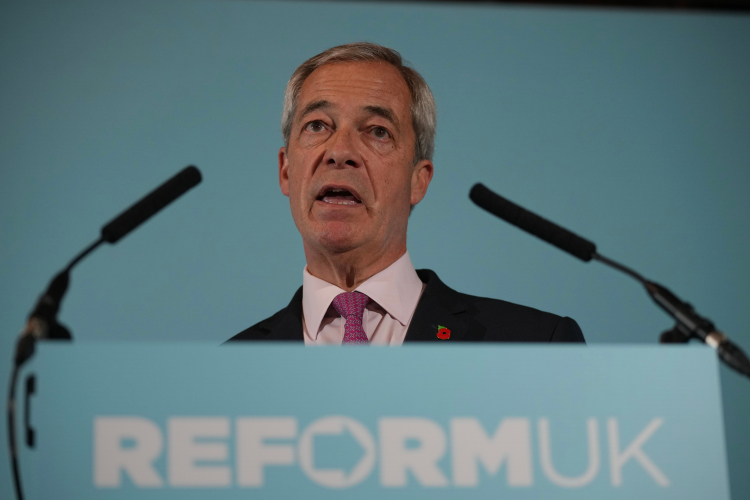
Ma’anit says a quiet political shift is happening among British Jews who are fed up and see Reform UK, Nigel Farage’s right-wing populist party that’s surging in popularity, as a credible political force. “It would be fair to say that Jews aren’t going to vote Reform,” he said, but he describes “a growing ease” among British Jews with Reform’s stances on policing, immigration, and terrorism. As a marker of Reform’s growing legitimacy, Stone’s Antisemitism Policy Trust attended the party conference in September to appear on a panel addressing how political parties can tackle and prevent conspiracy theories.
In the meantime, Stone says he and other British Jewish leaders are cautiously optimistic about the current government’s commitment to combating antisemitism. “Every meeting that I’ve been in with Jewish communal bodies, the response has been that the government has responded well,” said Stone, “but there are more actions that need to be taken before I think they’ll have a full vote of confidence.”
Ma’anit said until now, not many British Jews have been moving toward the exits. He says that the expense of moving and the cost of living in Israel – by some measures among the highest in the developed world – are obstacles for many. And among those who might still be inclined to consider a move, a glance at Prime Minister Benjamin Netanyahu’s far-right, controversial governing coalition in Israel may strike Britons, who have their own fractious political scene at home, as something of a busman’s holiday. “A lot of British Jews aren’t really big fans of the Israeli government at the moment,” he said.
More importantly, Ma’anit said, Great Britain is their home. The Board of Deputies of British Jews, to which he belongs, for example, was founded in 1760. A British-Israeli citizen, Ma’anit said that much of Britain’s Jewish population predates the arrival of refugees fleeing the Holocaust. “They’ve been here for generations,” he said, noting that the majority are descended from the Jewish families that Oliver Cromwell invited to settle in England in the 17th century.
“Every Brit in this country in their Sabbath and their Shabbat service will sing the national anthem and say a prayer to protect the King,” he said. “They’re very British, and they’re very patriotic. So it’s very difficult to think about leaving.”
